Thursday, April 30, 2009

Test Taking Strategies


I thought I might offer a few suggestions for your students as they continue taking the various tests that are administered at the end of the academic year. The list is definitely not inclusive, but just some of my personal favorites:

Prior to taking a test: (provided by TestTakingTips.com)
1. Preparation for your first test should begin after the first day of class; this includes studying, completing homework assignments and reviewing study materials on a regular basis.
2. Budget your time, make sure you have sufficient time to study so that you are well prepared for the test.
3. Go to review, pay attention to hints that the instructor may give about the test. Take careful notes and ask questions about items you may be confused about.
4. Ask the instructor to specify the areas that will be emphasized on the test.
5. Make sure you go to the class right before the test; it's another prime time for the instructor to give out more hints or the format of the test.
6. Go over any material from practice tests, HW's, sample problems, review material, the textbook, class notes...
7. Eat before a test, having food in your stomach will give you energy and help you focus, but avoid heavy foods which can make you groggy.
8. Don't try to pull an all nighter, get at least 3 hours of sleep before the test.
9. Put the main ideas/information/formulas onto a sheet that can be quickly reviewed many times, this makes it easier to retain the key concepts that will be on the test.
10. Try to show up at least 5 minutes before the test will start.
11. Set your alarm and have a backup alarm set as well.
12. Go to the bathroom before walking into the exam room, you don't want to waste anytime worrying about your bodily needs during the test.
1. Read the entire question before looking at any of the answers.
2. Formulate your thoughts. In other words, come up with the answer before looking at the possible answers.
3. Read all of the choices.
4. Eliminate answers you know aren't right.
5. Choose the correct answer.
6. If you aren't totally sure of the correct answer take an educated guess and select an answer.
7. Don't keep changing your answer. Your first choice is usually the right one (unless you miss-read the question).
8. In "All of the above" and "None of the above" choices, if you are certain one of the statements is true don't choose "None of the above" or one of the statements are false don't choose "All of the above".
9. In a question with an "All of the above" choice, if you see that at least two correct statements, then "All of the above" is probably the answer.
10. A positive choice is more likely to be true than a negative one.
11. If there is an "All of the above" option and you know that at least two of the choices are correct select the "All of the above" choice
12. Usually the correct answer is the choice with the most information.
13. Take the time to check all of your answers before handing in/submitting the test.

If you absolutely have no clue:
Try among the following recommendations offered by Dennis H. Congos, Certified Supplemental Instruction Trainer at the University of Central Florida:

1. Choose the most general answer when other choices are specific.
2. Choose the longest answer when others are much shorter.
3. Choose the answer with a middle value when other answers are higher or lower.
4. Choose neither of the similar answers.
5. Choose one of two opposite answers.
6. Choose the answer that agrees grammatically. (For ex: a, and an = singular, are = plural.)
7. Choose the answer most synonymous with key words in the question or statement.
8. Count the number of blanks in fill-in questions or statements.
9. Choose from among familiar answers. Avoid unknown options.
10. Choose the most logical answer to you.
11. Avoid answers with absolutes in them. (Examples are always, never, every, none, all, only.)

Tuesday, April 28, 2009

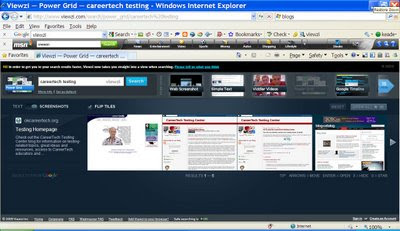
Viewzi

I just found a new search engine while reading the Unquiet Library blog. According to the blog, "In a nutshell, Viewzi searches a wide range of content, including websites, videos, mp3 files , images, news sites, and Google Books; it can generate tag clouds related to your search and allow you to search content related to those tags, too!

I think students, especially visually oriented learners, will enjoy this graphic way of searching and exploring results! I am looking forward to exploring this fun alternative search engine.

You can read more about Viewzi in this Read Write Web article; you may also want to check out this TechCrunch article. Follow Viewzi on Twitter! for updates and news on Viewzi."

Here is a screen shot from when I searched for CareerTech Testing:


I did a few searches and really liked what I saw. Take a look and tell me what you think??? J.T.

Thursday, April 23, 2009

World Digital Library

Humanity's Earliest Written Works Go Online


PARIS (AP) -- National libraries and the U.N. education agency put some of humanity's earliest written works online Tuesday, from ancient Chinese oracle bones to the first European map of the New World.

U.S. Librarian of Congress James Billington said the idea behind the World Digital Library is not to compete with Google or Wikipedia but to pique young readers' interest — and get them reading books.

"You have to go back to books," Billington said in an interview in Paris, where the project was launched at UNESCO's headquarters. "These are primary documents of a culture."

A Web site in seven languages — English, Arabic, Chinese, French, Spanish, Portuguese and Russian — leads readers through a trove of rare finds from more than a dozen countries. Among them: a 1562 map of the New World; the only known copy of the first book published in the Philippines, in Spanish and Tagalog; an 11th-century Serbian manuscript; and the oracle bones — pieces of bone or tortoise shell heated and cracked and inscribed that are among the earliest known signs of Chinese writings.

It also has early photographs, films and audio tracks. For now, searches on the site produce no more than a few hundred items in any category. But Billington says the project is ready to expand as other national libraries join in with the 32 libraries and research institutions already involved.

He insists the idea is quality, not quantity. "It's not an online bibliography," he said. "These pieces are one of a kind, or available in just a very few places. ... You don't get that elsewhere." The site provides page-by-page viewing of the original works, scanned in by the national libraries that took part in the project, often with multilingual narration by curators. It unites items about one subject but held in different countries, in a kind of online retrospective. "It brings together cultural heritage that's scattered around the world," Billington said.

The site is aimed at researchers, teachers and schoolchildren worldwide. While its offerings are fairly narrow, Billington sees it as a starting point, "an entryway to learning for those who are living in an audiovisual world."

The concept is modeled on the Library of Congress' American Memory project, which debuted in the 1990s and now has 11 million history-related items online. The partners in the World Digital Library project, including national libraries of countries from Iraq to Uganda and Russia, argued over how to finance it — the funding comes from private and public sources — and how best to translate it. But they all agreed on the need for such a global repository, Billington said.

He hopes it gets readers interested in a topic or historical period and then nudges them toward real libraries to read more about it. "Books have to be read so you can appreciate these treasures," he said.

I was sent a copy of the AP press release (thanks JLa!) and I thought you might enjoy another resource for research. The WDL also presents the following as their mission:

The World Digital Library (WDL) makes available on the Internet, free of charge and in multilingual format, significant primary materials from countries and cultures around the world.

* The principal objectives of the WDL are to:
* Promote international and intercultural understanding;
* Expand the volume and variety of cultural content on the Internet;
* Provide resources for educators, scholars, and general audiences;
* Build capacity in partner institutions to narrow the digital divide within and between countries.

Monday, April 20, 2009

The Pygmalion Effect: Are You Guilty?

After administering hundreds of cognitive and achievement tests over the years and listening to a few teachers or even watching little league sports, I am aware that the Pygmalion effect does exist, but I wonder at what level?

According to Wikipedia, the Pygmalion effect, (or Rosenthal effect, or Expectancy Effect), refers to situations in which students perform better than other students simply because they are expected to do so. The effect is named after George Bernard Shaw's play Pygmalion, in which a professor makes a bet that he can teach a poor flower girl to speak and act like an upper-class lady, and is successful.

The Pygmalion effect requires a student to internalize the expectations of their superiors. It is a form of self-fulfilling prophecy, and in this respect, students with poor expectations internalize their negative label, and those with positive labels succeed accordingly. Within sociology, the effect is often cited with regards to education and social class.

In the Rosenthal-Jacobson Study, Robert Rosenthal and Lenore Jacobson (1968/1992) report and discuss the Pygmalion effect at length. In their study, they showed that if teachers were led to expect enhanced performance from some children, then the children did indeed show that enhancement.

The purpose of the experiment was to support the hypothesis that reality can be influenced by the expectations of others. This influence can be beneficial as well as detrimental depending on which label an individual is assigned. The observer-expectancy effect, which involves an experimenter's unconsciously biased expectations, is tested in real life situations. Rosenthal posited that biased expectancies can essentially affect reality and create self-fulfilling prophecies as a result.

In this experiment, Rosenthal predicted that, when given the information that certain students are brighter than others, elementary school teachers may unconsciously behave in ways that facilitate and encourage the students’ success. The prior research that motivated this study was done in 1911 by psychologists regarding the case of Clever Hans, a horse that gained notoriety because it was supposed to be able to read, spell, and solve math problems by using its hoof to answer. Many skeptics suggested that questioners and observers were unintentionally signaling Clever Hans. For instance, whenever Clever Hans was asked a question the observers' demeanor usually elicited a certain behavior from the subject that in turn confirmed their expectations.

The issue of teacher effects, on student progress, and how students rate those teachers is of huge importance. Tim O'Shea has said that in all studies where one of the variables was the teacher, the effect of different teachers was always bigger than the effect of different treatments (usually the actual subject to be studied). Basically, teachers have a huge effect, but it's poorly understood.

The Pygmalion effect is one big demonstration of the effect of teachers, showing they can double the amount of pupil progress in a year.

Feldman & Prohaska (1979) performed an experiment to study the effect of student expectations of teachers. One group was told their teacher was "quite effective," and another group was told their teacher was "incompetent." The effect of these positive and negative expectations were measured in terms of student attitudes toward the teacher, scores on tests, and "nonverbal behavior" of the students toward the teachers. The teacher was blind to what the students thought about him/her. There were clear differences in all three measures based on a positive or negative expectation. Students with a negative expectation "rated the lesson as being more difficult, less interesting, and less effective." Students with a positive expectation scored 65.8% on the test, and those with a negative expectation scored lower, at 52.2%. In terms of nonverbal behavior, subjects leaned "forward more to good teachers than poor teachers." There was some evidence that students with a positive expectation had better eye contact with the teacher. Overall, the expectation of the teacher affects overall learning outcomes.

I would like to finish with a couple of quotes from James Rhem, executive editor for the online National Teaching and Learning Forum. He commented:

"When teachers expect students to do well and show intellectual growth, they do; when teachers do not have such expectations, performance and growth are not so encouraged and may in fact be discouraged in a variety of ways."

"How we believe the world is and what we honestly think it can become have powerful effects on how things turn out."

In other words, as instructors, you have a tremendous amount of power and influence and you can change a life!

Thursday, April 16, 2009

Before He Cheats - A Teacher Parody

The testing season is definitely upon us and I found a video that I thought you might enjoy. It's a parody of Carrie Underwood's video "Before He Cheats" and it deals with a cheating student from the teacher's perspective. It's filmed on location at the Rock School in Gainesville, Florida.


Related Posts Plugin for WordPress, Blogger...
 
MDZE3SGDZH9Y